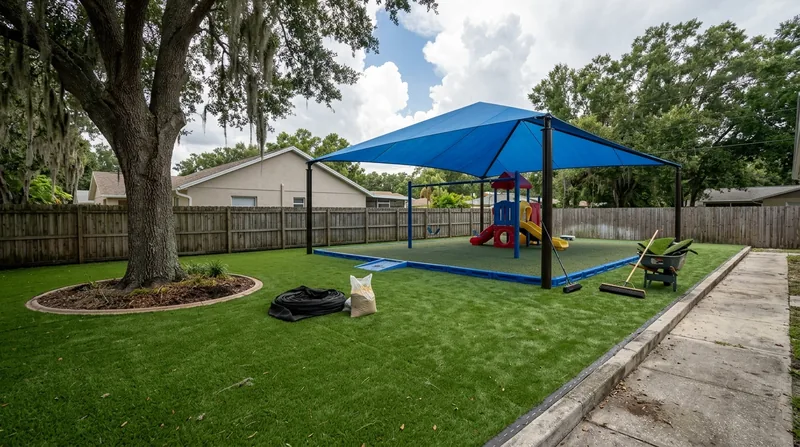




Playground & School Turf in Tampa solves a problem that keeps facilities managers and HOA boards up at night: mulch washes out in summer thunderstorms, sand migrates into classrooms and parking lots, and maintenance costs climb every season. Tampa's flat terrain, sandy soil, and daily afternoon storms from June through September make traditional playground surfaces unreliable. Schools and parks across Tampa, Temple Terrace, Plant City, Carrollwood and Westchase face the same challenge: engineered wood fiber compacts, shifts, and erodes. We install synthetic turf with engineered fall-height padding under play structures, accessible pathways, and drainage systems that handle Tampa's intense rainfall without washout. Our work is scheduled around the school calendar, and every installation comes with a written specification naming the turf product, face weight, pile height, infill type and pounds per square foot, and base depth. This is how you verify any turf installer, including us.
Why Playground & School Turf Matters in Tampa's Climate
Tampa Bay's summer weather is unforgiving to traditional playground surfaces. The region receives over 50 inches of rain annually, with the heaviest downpours concentrated from June through September. Each thunderstorm moves mulch and sand off the play zone, exposing hard-packed earth or creating drainage pooling that becomes a safety hazard and a maintenance nightmare. Facilities also face the wear of year-round use: Florida's heat and humidity accelerate decomposition of wood fiber, and the combination of moisture and heat creates conditions for mold and mildew. Synthetic turf eliminates these failure modes entirely.
- Engineered fall-height padding stays in place through hurricanes and daily storms, meeting ASTM F1292 impact attenuation standards without annual top-dressing.
- Drainage is engineered into the base and pad system, so water runs through rather than pooling on the surface.
- UV-stabilized turf resists Florida's intense sun and salt air if the facility is near the bay or coastal areas.
- Maintenance shifts from raking, replacing mulch, and inspecting for hazards to periodic brushing and occasional rinse cycles.
- Installation can be scheduled during summer break or winter recess, minimizing disruption to the school calendar.
These benefits reduce liability exposure and free up grounds staff to focus on other campus needs.
Key info: Playground turf in Tampa must meet ASTM F1292 impact attenuation standards for the height of the play structure. We specify the turf, pad thickness, and infill depth in writing so your facility meets safety requirements without guesswork. The Florida Department of Education does not mandate artificial surfaces, but many schools choose them for safety, durability, and maintenance cost recovery over 8 to 12 years.
For official guidance on playground surface standards, see the ASTM F1292 standard for impact attenuation, which governs fall-height certification nationwide.
How We Install Playground & School Turf: The Process
A playground turf installation in Tampa requires careful sequencing to meet safety standards and handle the local soil and drainage conditions. We start with a site survey to assess tree cover, existing drainage, and the footprint of play structures. Sandy Tampa soil drains quickly, but compaction and base preparation are essential to prevent settling and to ensure the pad system works as designed. We coordinate around the school calendar and often schedule work during breaks to avoid disrupting classes and recess.
- Measure the play zone and mark the boundary, accounting for the fall zone (the area around equipment where a child might land).
- Remove existing mulch or worn surface material and dispose of it responsibly.
- Grade the base to ensure proper drainage away from buildings and toward storm drains or drainage swales.
- Compact the base in lifts to prevent settling and ensure a stable foundation for the pad system.
- Install engineered fall-height padding (typically 1.5 to 2.5 inches, depending on structure height and ASTM requirements).
- Lay synthetic turf, seaming it carefully so edges are secure and flush with the pad.
- Infill the turf with engineered sand and crumb rubber (or alternative infill) to achieve the specified depth for impact attenuation and drainage.
- Brush the turf pile to stand upright and achieve the final appearance and performance.
The entire process typically takes 3 to 5 working days, depending on the size of the area and site conditions. We work with school administration to minimize disruption and often complete work before students return.
Local example: A Carrollwood elementary school with a 2,500 sq ft play zone under a 12-foot climbing structure required 2 inches of fall-height padding to meet ASTM F1292. We removed compacted mulch, graded the base, installed the pad and turf, and infilled with engineered sand and crumb rubber. The job took 4 days and was completed before the school year started. The facility has had zero maintenance calls in three years.
Learn more about how we handle commercial artificial grass installation for properties with similar durability and safety demands.
Playground Turf Installation Methods: What Works in Tampa
| Approach | Description | Best for |
|---|---|---|
| Full-depth engineered pad system | Turf + engineered foam or rubber pad (1.5 to 2.5 inches) + infill (sand and crumb rubber). Base is compacted soil or recycled asphalt. | High-impact play structures, climbing equipment, and any installation where ASTM F1292 impact attenuation is required. |
| Accessible pathways | Turf installed over a firmer base (typically 4 to 6 inches of recycled asphalt compacted to 95% density) with reduced infill depth for ADA compliance and wheelchair access. | Paths connecting play zones, shaded rest areas, and accessible routes to equipment. |
| Drainage-first base for wet sites | Deeper base (6 to 8 inches of compacted recycled asphalt or gravel) with perimeter swales or French drains to handle Tampa's heavy rainfall and prevent ponding. | Low-lying areas, sites with poor natural drainage, or facilities where water pooling has been a problem. |
| Shaded zones under live oaks | Turf rated for partial shade (typically 4 to 6 hours of direct sun per day) with lighter pile height and infill to reduce heat absorption and allow moisture to dry faster. | Play areas beneath Tampa's mature live oaks and laurel oaks where tree canopy is dense and drainage is critical. |
Playground & School Turf Cost in Tampa: What to Expect
The cost of playground & school turf installation in Tampa typically ranges from $10 to $16 per square foot, depending on site conditions, pad specifications, and infill type. A 2,500 sq ft play zone might run $25,000 to $40,000 installed, with the majority of that cost going to the engineered pad system and proper base preparation. Tampa's sandy soil and drainage requirements mean base work is not optional, and facilities that skip it end up with settling and premature failure. Larger installations (5,000+ sq ft) and multi-zone projects often see per-square-foot pricing trend lower due to efficiency and material volume.
Several factors move the cost up or down within that range:
- Fall-height pad thickness (taller play structures require thicker pads to meet ASTM F1292 impact attenuation, increasing material and labor cost).
- Existing surface removal and disposal (compacted mulch, old turf, or concrete removal adds labor and haul fees).
- Base condition and grading (sandy Tampa soil sometimes requires deeper compaction or drainage work to prevent settling).
- Tree canopy and root systems (work around mature live oaks and laurel oaks requires careful routing and sometimes hand-digging rather than machinery).
- Infill type (engineered sand and virgin crumb rubber are standard; alternative infills such as organic or cooling variants cost more).
- Accessibility requirements (ADA-compliant pathways and ramps increase the total square footage and complexity).
Getting 2 to 3 written estimates is smart. Each estimate should name the turf product, face weight, pile height, infill type and pounds per square foot, base depth, and pad thickness so you can compare apples to apples. See our full pricing overview for more detail on how we break down costs and what is included.
Real example: A Westchase HOA park with a 1,800 sq ft play zone and two structures (8 feet and 10 feet tall) required 1.5 inches and 2 inches of fall-height padding respectively. Existing mulch was removed, the base was graded and compacted to 95% density, and turf with engineered sand and crumb rubber infill was installed. Total cost was $21,600, or $12 per sq ft. The facility has been in service for two years with no maintenance beyond occasional brushing and rinse cycles.
Playground & School Turf Near Me: What to Look for When Hiring a Turf Installation Company
Choosing the right turf installer for a school or HOA playground is not simply about finding the lowest price. A poor installation wastes money and creates safety liability. We recommend a straightforward vetting process that applies to any turf company, including us. Start by asking whether the installer is fully insured and can provide a certificate of insurance naming general liability and workers' compensation. Call their references and ask specific questions: Did the turf stay in place through Tampa's summer storms? Has the drainage system performed? Did the installer finish on schedule and clean up properly?
Second, request a written specification before signing a contract. This document should name the turf product (brand and model), face weight in ounces per square yard, pile height in millimeters, infill type and pounds per square foot, base depth, and pad thickness. If the installer cannot or will not provide this in writing, walk away. You cannot verify a playground surface meets ASTM F1292 impact attenuation without knowing the pad thickness and infill depth. Third, confirm that the installer understands local permitting. Most playground turf does not require a building permit, but grading that changes drainage patterns or work within a right-of-way may trigger city or county review. The installer should defer to the local building department and never promise approval.
Ask how the company handles the school calendar. Quality installers schedule work during breaks and minimize disruption. Also confirm that the installer will coordinate with your grounds team on maintenance expectations after installation. Playground turf is low-maintenance, but it is not maintenance-free. Brushing the pile upright 2 to 4 times per year and occasional rinse cycles keep the surface performing well.
Ready to move forward? Contact us for a free estimate. We respond within 24 hours and provide a written spec before any work begins. Call (786) 461-1575 or fill out our online form with details about your play zone, structure heights, and timeline.
Playground & School Turf in Tampa: Pricing Guide
| Service | Price | Details |
|---|---|---|
| Standard playground turf with fall-height padding | Starting at $10/sq ft | Includes turf, engineered pad (1.5 to 2 inches), base prep, and infill for structures up to 8 feet tall |
| High-impact zones and tall structures | Starting at $13/sq ft | Thicker fall-height padding (2 to 2.5 inches) and engineered sand infill for structures 8 to 12 feet tall |
| Multi-zone playgrounds with accessible pathways | Starting at $11/sq ft | Play zones plus ADA-compliant pathways, firmer base for wheelchair access, and coordinated drainage |
| Complex site with drainage work or tree removal | On estimate | Sites requiring deeper base prep, swales, French drains, or work around mature live oaks need an on-site assessment |
| Travel and site visit | Included | Free estimate within Tampa service area, response within 24 hours, no obligation to book |
Indicative pricing, the exact cost depends on square footage, finish, and site access. Free personalized estimate within 24h at (786) 461-1575.


